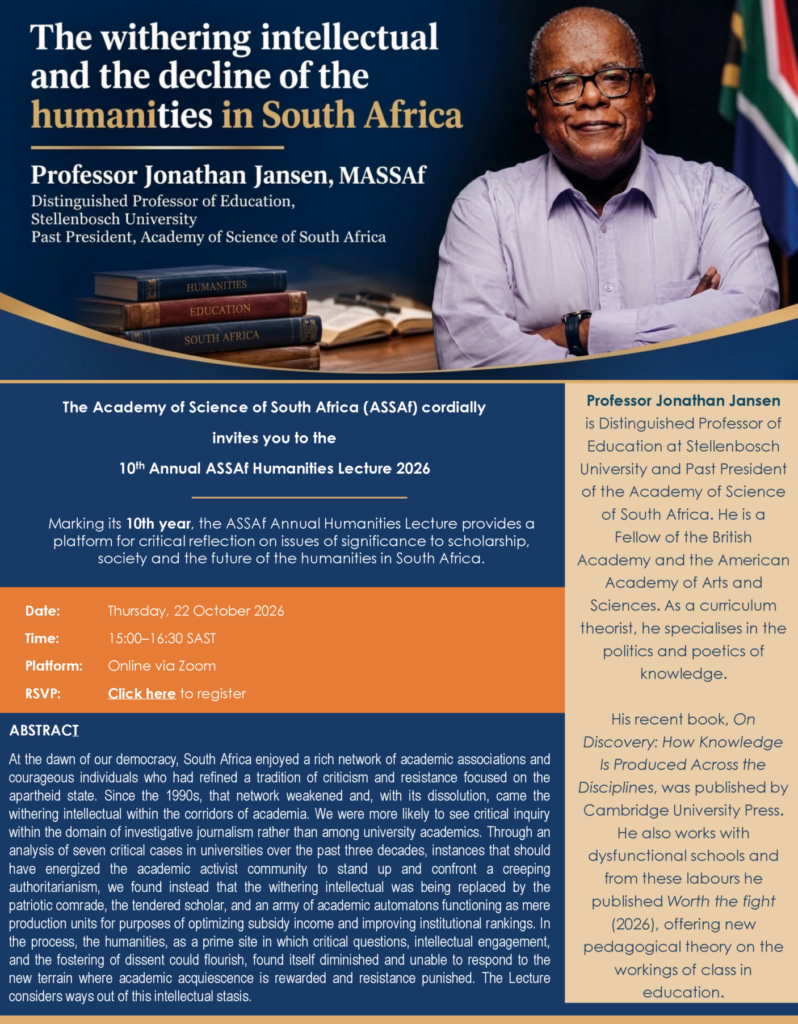
The wilting intellectual and the decline of the humanities in South Africa
Jonathan D Jansen
Stellenbosch University
22 October 2026
- I should start by congratulating the Academy on its 30th Anniversary and for this occasion, the 10th Annual Humanities Lecture. I especially want to express appreciation for the collective leadership of the Academy under our stolid President, Professor Thokozani Majozi and our effervescent Executive Officer, Professor Himla Soodyal. Who said that process engineering and population genetics cannot mix?
- Allow me to give a shout out to our grade 11 physical science class from Crestway High School on the Cape Flats to whom I taught physics as a human endeavor. Welcome, bright sparks!
- What has happened to us?
- At the dawn of our democracy, South Africa enjoyed a rich network of academic associations and courageous individuals (some scholars died in the struggle, First, Webster, Turner etc.) who had refined a tradition of criticism and resistance focused on the apartheid state. Since the 1990s, that network weakened and with its dissolution came the wilting intellectual within the corridors of academia, and the corresponding decline of the humanities.
- Consider this extended metaphor from the botanical sciences to illuminate my subject.
- The wilting intellectual at one time stood tall, unbending against the winds of power with a principled position on matters of academic freedom that resisted state interference with respect to which students to enroll, whom to appoint to the staff, and what to teach. However, like trees with shallow roots and thin leaves, the wilting intellectual drooped under the heat of political pressure and the seduction of material gain, losing its once admired moral turgidity.
- What do I mean by the humanities?
- Unlike most writing that declares the decline or disappearance of the humanities in reference to departments or curricula or programs (consider Toby Miller’s The end of the humanities as example), my departure point is different. For purposes of the Lecture I will define the humanities (including, for the moment, the social sciences) as a set of ambitious ideas for learning and living that has as its rationale three objects.
- One, a dispositional orientation towards questions about the world that envelops us. Persistent questions. Persistent questions, why questions, in particular, about the social and the physical world around us.
- Two, an intellectual commitment to reading that intellectual expands thinking beyond the confines of a starting discipline or a singular tradition or simple narratives.
- Three, a facility in criticism, that human ability to make informed judgments about complex issues that brings with it the capacity for self-reflection and change.
- By that definition of the humanities, higher education in South Africa is in serious decline; in fact, it is not higher at all.
- How did this happen?
- To understand the decline of the humanities in South Africa it is vitally important to recognize one of most important transformations in schools and universities over the past 30 years.
- I will argue that this decline has its roots in the narrowing down of the purposes of education that runs with remarkable ease from the first grade of school through the undergraduate programs of universities
- In schools, for example, the stubborn multi-year data on reading (8 out of 10 grade 4’s cannot read for meaning) reflect a deeper, disturbing reality that refuse resolution through all kinds of interventions: Children do not read, teachers do not read
- Are we entering a post-literacy era, as Rose Horowitch argued in a widely cited article in The Atlantic (June 2026)? She claims that “the end of reading is here” and that “the age of reading might be a short anomaly in human history.” Horowitch concludes that the world’s wealthiest country is becoming postliterate.
- The decline is made worse in the digital age where children now read “textual fragments” where text messages substitute for deep reading and “the higher order abilities of comprehension and synthesis.”
- The incapacity to read deeply or at all has already done great damage to the capacities of children to imagine or name through language the worlds around them—both core attributes of the humanities. Instead, our children have been turned into machines with a singular distorted purpose—preparing for and passing terminal examinations. Having worked in high schools for the past three years, it is clear that education has been replaced by a form of training that is laser-focused on scholastic results.
- in my recent book, Worth the fight (2026), I described at close quarters the competition in schools to improve the NSC (matric) results It is almost unreal: the dropping of ‘difficult subjects’; the get-them-over-the-line strategies; and the substitution of broader learning for the maniacal revision of past exam papers has turned our children into automatons feverishly performing for school reputation rather than pursuing deep learning for an education enriched with attributes associated we associate with the humanities.
- With one foot in schools and the other in undergraduate education, I have witnessed first-hand the damage carried over during this transition from schools to universities. In my third year education policy course students from the most elite schools in the country with fees sometimes exceeding R100,000 fail like flies in the first 3-4 tests. In my tutorials, they confess: Sir, in school we were taught as papagaaie (parrots). Their words: repetition, memorization, regurgitation.
- At one of the make-up tutorials, a student bleated out this statement in front of her friends: “Sir, I can now see what you’re trying to do.” I was now on full alert, wondering what she thought I was doing. Then this, “You require us to think!” (I quietly mumbled the words of the Biblical Simeon: Lord, take me home; my work on earth is done).
- The re-treading of schools as sites of disgorgement finds its parallels in the South African university which has also been deeply transfigured by teaching as coverage, the atomization of learning (unit standards, modular units, credit hours etc.) and a factory model of research production that now infuses all our work.
- In particular, the negative incentives of state funding for research has turned academics into machines working relentlessly to optimize, under pressure, research outputs (the term giving itself away). The dean or the head of department wants 1.5 research outputs per annum, something like that.
- Just this week Business Day reported the Minister’s intention to push back against “the gaming of the system” including “unethical and fraudulent practices ranging from hyper-publication to self-published books.” The following terms are now familiar to many: predatory journals, salami-slicing, gift authorships, and unsolicited articles. Last year one academic submitted 125 articles and 30 conference presentations all in an attempt to milk the system for personal and institutional benefit.
- For purposes of this Lecture I am less interested in the corruption of the academic project (that I have written about elsewhere, in my book Corrupted) than in how these practices have become normalized within higher education. Ask yourself, how and why did universities (we know this from CREST reports) allow for this distortion of higher academic purposes?
- For more than three decades the purposes of higher education have been deeply transformed first through the representation of teaching and learning as process of structural reorganization. SAQA, for example, did not transform our understanding of knowledge, in fact it diminished such quests into regulatory standards requiring compliance, not critical knowledge spawning criticism, questioning and the possibility of dissent. Statutory bodies like the CHE were circumscribed by legislation as timid advisory bodies to government, not critical authorities asking uncomfortable questions of those in power.
- But what about academics themselves?
- As a consequence of their capitulation, when crises happened on campuses, universities were so deformed by rampant corruption, pre-emptive obedience, and compliance cultures, they were unable to respond with the facility that the humanities provide. Academics would find themselves encaged by their own complicity. Under these conditions, three academic types emerged:
- First, there is the patriotic comrade, You would find them populating the science councils and acting as “advisors” to government, all dressed up in self-importance. To see more of them, look no further that the government’s humanities institute rewarding patriotic research. Yes minister, no minister, of course minister. The level of obsequiousness is something to behold. The patriotic comrade has given up any sense of the critical and the engaged; he reads not widely but narrowly the policy prescripts of the state and positions himself as an implementer, not a thinker, of one decadal plan after another.
- Second, there is the tendered comrade. This academic spends a sizeable chunk of their time making extra funds from government (and private sector) contracts to optimize income. The tendered comrade is super-sensitive to being critical of their paymaster because that could threaten positions on statutory bodies, VVIP invitations to gowned events, shortlists for administrator or vice-chancellor positions, and contracts for funded work.
- Third, there is the metricized comrade. As mentioned earlier, these academics work non-stop to game the subsidy system for research outputs. The more money they make through scores of publications per annum, the more funding into their personal accounts. Some universities give back 100% to the individual while in other cases institutions enjoy a percentage split in research income. The institutional benefit is the single most important reason why vice-chancellors do not intervene in corruption scams of their academics. Such lack of capacity for self-governance is what brings a Minister into the fray, threatening other academic freedoms.
- What does this transfigured university means for the humanities? My thesis is simple: that the transfigured university is a product of a sea-change in the understanding of higher education as a carrier of humanities thinking. Over time, this sea-change led to the dismantling of the democratic university and the problem becomes abundantly clear when crises show up at the gates. Five brief examples.
Case A: decolonization
- When that short and necessary moment of the mid-2000s called for decolonization, what struck me was the singularly uncritical (let alone un-strategic) response of academics to this unfamiliar language in South African struggle history. There were no critical questions like: Why now? Whose is the colonial subject? How is it even possible to use tired grids from the 1970s of North/South when how knowledge is actually produced defies those simple binaries? And, most importantly, why would a widespread narrative of Northern domination so easily belittle African agency? The political imperative not only impaired but also censured criticism.
Case B: academic xenophobia
- When the Parliamentary Portfolio Committee launched an unrelenting assault on university vice-chancellors for the employment of foreign nationals, most of our leaders were tied in knots. Few, if any, made the argument for the constitutive nature of the university, that it is not a department of state, and that no government can instruct institutions as to which academics to appoint. In other words, at such a crucial moment, important humanities questions evaded our leaders, questions such as
- What is a university?
- What does it mean to be human?
Again, this is a consequence of the impairment of humanities thinking.
Case C: The right to free speech
When in response to the xenophobic utterances of the PPC, Professor Sioux Mckenna of Rhodes University was personally targeted by the chair of that body in ways not seen since the days of apartheid authoritarianism. I still remember reading these chilling words from the chair of the PPC drawn from a television interview in March of this year:
“When you see people write about us, saying this and that, you know, they interest us. What is it that they don’t want us to go to? Already we have our eyes on Rhodes University because of [an] opinion piece by Prof McKenna. I can tell you, there, we will find something.”
Academic responses were few and far between, not enough standing up and rejecting this kind of thuggery from the PPC chairman. An exception was McKenna’s vice-chancellor, Professor Sizwe Mabizela who responded in firm but measured tone in defense of academic freedom.
When Wits academic Srila Roy, in frustration at the xenophobic attacks on academics, said South Africans “have little ambition, are complacent, and have poor work ethic,” there was a fierce backlash not only from students but from the South African Sociology Association (SASA), which should have known better. Wits leadership came under enormous political pressure and placed the head of sociology on precautionary suspension. Roy’s apology meant nothing because there was blood in the water and the academic sharks pounced. Was she wrong? Maybe. Did other politicians say similar things about our work ethic? Many. Then why the attack on a woman of colour? She was from India, she was a woman, and she was speaking out of turn. Very few, if any, academics made the case for her right to academic freedom and it would be a profound tragedy if Wits University disciplined this colleague.
Case D: The genocide in Gaza
When it dawned on humanity that there was a genocide of horrific proportions in Gaza, I was struck by how hard it was for academic senates and councils to find common ground in condemning this flattening of humanity, where more than 64000 children had been killed or maimed by the Israeli government since 2023. Academics (and administrators) took on hard, partisan lines and few dwelt on that most fundamental of humanities questions: what does it mean to be human inside this catastrophe? There was in fact no moral vocabulary for speaking about this genocide because our universities had been downgraded years ago into spaces where the cultivation of empathy was not part of the human purposes of education.
Case E: the pandemic
No event in recent history demonstrated the dangers of non-humanities thinking than when the pandemic engulfed South Africa. Despite warnings, the minister’s panel consisted of infectious diseases experts, immunologists, and other health sciences specialists but nobody from the humanities. Soon it dawned on colleagues in the biomedical sciences that “social distancing” in its medicalized meaning was not only normed for middle class sensibilities, it was deadly when imposed on humans in crowded shacks. My point is not the absence of humanities thinking, that too; it is about an orientation to knowledge that does not place the whole human being at the center of the scientific or scholarly enterprise.
- By contrast, what do universities with a thriving culture of humanities thinking do? They enable students to ask discomfiting questions, to make reasoned judgments, to engage difficult subjects, to respect other views, to launch public arguments, to be comfortable with uncertainty, and to allow for the possibility that they might be wrong.
- It should now be clear that humanities thinking is not something that can or should be contained within traditional humanities departments such as history, literature or anthropology. Humanities thinking, as defined, should be present in quantum physics or electrical engineering or clinical immunology.
- For example, in teaching my undergraduate class this year about the impact of humanoid robots and artificial intelligence on classroom instruction, their engagement with George (the name of the robot developed by colleagues in electrical engineering at Stellenbosch University) was strikingly focused on human questions. “George, will you take my job,” one of the students asked the robot a few weeks ago and we engaged in long debates on the importance of human emotions in pedagogical engagement that make human teachers indispensable, for the moment.
Conclusion
- How do we get out this conundrum? We need to introduce entry level courses and first year orientation sessions on the purposes of the university. We should encourage university leaders to develop core curricula in which young people engage the big human questions at the heart of our existence—long before being dispersed to learn the technical requirements for becoming an urban planner or sociologist or economist. We need to model through our academic teachers the ways in which to engage the subject and the world. In short, to introduce humanities in and against the powerful tide of managerialism, authoritarianism and the race to the bottom for academic metrics.
- I am waiting, by the way, for a courageous vice-chancellor who would require every undergraduate student to read at least one book from cover to cover, books such as A brief history of time (Hawking) or Things fall apart (Achebe) or The comrades wife (Boswell). To learn, in other words, not only the discipline of reading but also engaging texts outside of their own disciplinary pursuits.
Postscript
Wilting in a plant is usually reversible but before a plant reaches what is called its permanent wilting point. I am optimistic because of my work in schools with children, in lecture rooms with undergraduates, and in universities with future professors, that there is a ready audience more than willing to bring back humanities thinking into science and scholarship—just this side of permanent wilting.
Link to stream: https://www.facebook.com/academyofsa/videos/1829968217999468/